

One of the greatest excitements when filling out your bracket: What team will be that special Cinderella. While it doesn't happen all too often, teams that go on Cinderella runs are impossible to forget, and every year offers a new opportunity for one to be born.
The term "Cinderella" is thrown around and doesn't have a solidified meaning. In this case, I am simply referring to any team seeded 13 or lower as a Cinderella candidate. Here's a look at the 16 lowest-seeded teams in the tournament, along with their chances of a first-round upset (out of five  ).
Use our Bracket Optimizer to create the perfect bracket! >>
No. 13 Seeds
Vermont Catamounts (28-5 SU; 19-13 ATS; 18-14 O/U)
Vermont might be one of the most underrated offenses in the tournament. After absolutely running the table in the American East, the Catamounts were given a 13-seed despite ranking 58th in KenPom, two spots higher than Miami. In Evan Miya’s lineup ranking, the starting five for Vermont has been the third-best lineup in adjusted efficiency in the nation.
Arkansas isn’t exactly the worst matchup for Vermont, but it absolutely isn’t a great one either. Arkansas will be the most athletic team Vermont has faced all season and the best defense by far. Providence is the only squad Vermont has faced that has a defense ranked in the top-100 and the Catamounts have fallen to three of the four toughest defenses they’ve faced all year.
Against other teams, I would be all-in for Vermont. There is still absolutely a path for Vermont to win, I just think Arkansas’ pace and athleticism will be too much for Vermont to advance far in the tournament. Even if they do, they’d run into the hypothetical gauntlet of UConn and Gonzaga.
Upset Potential:
Akron Zips (24-9 SU; 17-14 ATS; 14-17 O/U)
Akron upset in the MAC tournament, but I can’t really see them upsetting here against the Bruins of UCLA. The firepower of UCLA should be too much for the Zips. This will be an incredibly slow game with few possessions so I am leaning to an Akron cover simply because the blowout risk is low, but I don’t see many avenues to Akron scoring at a high rate either.
UCLA is incredible at limiting transition points and second-chance looks, so the Zips have to be perfect offensively – only ranking 113th in the nation in offensive efficiency – in order to pull off an upset. They would also have to stop UCLA scoring, and I don’t see how they do it with UCLA’s high number of weapons. The slow pace and Akron’s momentum help them here, but I don’t see a path for them upsetting the Bruins.
Upset Potential:
Chattanooga Mocs (27-7 SU; 17-15 ATS; 17-15 O/U)
The Mocs could be one of the most well-rounded teams in the tournament. Malachi Smith is an efficient guard who can get to the charity stripe and defend well. Silvio De Sousa is a former Kansas big with Power 6 experience and a high usage rate. David Jean-Baptiste was the Southern Conference tournament star who is a capable deep shooter, and Darius Banks and AJ Caldwell are effective role players.
If Illinois does what it should – force-feed Kofi Cockburn down low – the Mocs might have trouble taking down the Fighting I’s. The thing is we generally haven’t seen that happen all too often. A high percentage of points comes from beyond-the-arc for Illinois, but the Mocs have one of the best three-point defenses in the nation.
This should be one of the best games in the first round. Both teams are well-rounded without any jarring holes in their offensive and defensive makeups. Illinois is a team arguably with the widest range of outcomes in this tournament, and one of them is to lose early. I love Mocs against the spread, and can easily see them taking down Illinois early.
Upset Potential:
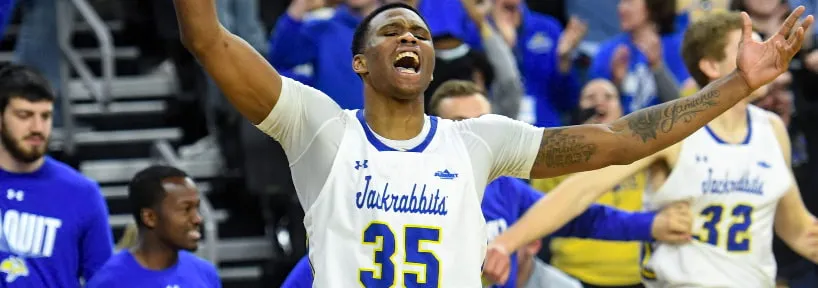
South Dakota State Jackrabbits (30-4 SU; 17-14-1 ATS; 17-15 O/U)
In case you haven’t heard, the Jackrabbits offensive might be the most exciting to watch among any tournament team. Their game against Providence should be as close as the two-point spread implies. While SDSU shoots at a ridiculous 44% clip from beyond-the-arc, all four of their losses have come when shooting below 37% from deep. Providence allows opponents to shoot 31% from deep.
On the other side, Providence has lost four of their five games when allowing opponents to shoot 39% or above from beyond the arc. So who wins the 3pt battle? That’s an incredible question. What I can potentially see as the crux of this game is foul trouble. Providence’s free throw rate is 12th highest in the nation, they force fouls and capitalize on charity stripe shooting. South Dakota State’s coach Eric Henderson prefers to keep players on the court with two fouls in the first half, which might come back to bite them at the end of the game. Don’t get me wrong, out of all these teams I am writing about, the Jackrabbits have the highest chance of making a Cinderella run, but I ever so slightly lean Providence in this game.
Upset Potential:
Check out all of our 2022 March Madness Coverage >>
No. 14 Seeds
Montana State Bobcats (27-7 SU; ATS 17-14-1; O/U 17-14-1)
The Big Sky rep is facing a tall task in taking on Texas Tech. When I say tall task, I mean gigantic task. Montana State has only faced a single team with a top-100 defense, and now they have to face the single best defense in the nation. What the Bobcats do well is reach the free throw line with their 4th best free throw rate in the nation. Texas Tech is prepared for this with its depth and ability to force turnovers.
In terms of spread covering, I see the referees having the biggest influence. If they are letting the boys play, Texas Tech covers easily. If they have a more conservative close, I think Montana State gives them trouble. Regardless, I cannot see the Bobcats taking down the Red Raiders. Mark Adams’ crew would seriously have to fall apart offensively, and Tech has done a solid job at avoiding that all year.
Upset Potential:
Yale Bulldogs (19-11 SU; 14-15 ATS; 13-15-1 O/U)
While Yale’s defense is their backbone, ranking 103rd in the nation and limiting Princeton in the Ivy League championship game, the Bulldogs have seen nothing like this Boilermakers offense. What benefits Yale is that the Ivy League has a history of surprising in round one, keeping games close. If any team is prone to come out lazy and sluggish out of the gates, it’s Purdue. Jaden Ivey sometimes doesn’t play defense, and they force no turnovers, so Yale should be able to put up a shot every possession.
Despite that, Yale’s offense doesn’t have much going for them. Where they can score is inside the arc, but I can’t imagine Yale being able to take on the Purdue size. If Purdue is playing at its best, this will be a 50-point game. Yale doesn’t have any makeup of a Cinderella team and I don’t really see any path of them winning this game.
Upset Potential:
Colgate Raiders (23-11 SU, 17-15-1 ATS, 16-17 O/U)
By far the most interesting 14-3 game. The Raiders of Colgate seem to be a staple of the tournament with their third-straight tournament appearance. A general Cinderella makeup includes luck and three-point shooting. Colgate appears to have both going for them. With the second-best 3pt shooting in the nation, this team is capable of shooting above 50% beyond the arc in any game.
When discussing luck, Colgate is the least lucky team in the tournament according to the KenPom luck metric. In addition, Wisconsin is the fourth luckiest team in the bracket. Odds suggest that both are due for regression, both in favor of Colgate. Matt Langel is a capable coach that has done incredible when his team is fully healthy considering most of their losses came on the road when they were missing their star Nelly Cummings. If Johnny Davis is any the bit not 100%, I really love Colgate to at least cover the spread and potentially pull off an upset. The bottom half of the Midwest bracket is a crapshoot, so there is a real path for Colgate to make a Sweet 16 run.
Upset Potential:
Longwood Lancers (26-6 SU, 19-9 ATS, 15-13 O/U)
Despite shooting at a 38.6% clip from beyond the arc, 5th best in the nation, I cannot say I am all too confident in Longwood’s Cinderella capabilities. The Lancers have shown their capabilities of adjusting when facing teams with solid 3pt defenses. In the six games where Longwood faced three-point defenses better than Tennessee, Longwood went 6-0.
Rick Barnes is known as a below-average tournament coach. But Tennessee has been on absolute fire of late and has handled teams who are prolific at shooting the long ball. There is the potential of Tennessee putting up a dud, but I am still confident in this Volunteers team handling Lancers.
Upset Potential:
No. 15 Seeds
CSU Fullerton Titans (21-10 SU, 16-11-2 ATS, 12-17 O/U)
I don’t want to spend too much time here. The Titans earned their spot out of the Big West and I would be utterly shocked if they pull off an upset over Duke with their sub-par offense and defense. Their one strength – their offensive free throw rate – Duke stifles easily on defense. We have seen great Duke teams be upset in the past. This time around, however, the Blue Devils have a delightful matchup to take down CSU Fullerton.
Upset Potential:
Saint Peter’s Peacocks (19-11 SU, 19-9-1 ATS, 11-18 O/U)
While the Peacocks arguably have the best mascot in the tournament, they also have the arguably most difficult draw. Despite their elite interior defense – ranking 11th in the nation at d2Pt%, I expect Kentucky and Oscar Tshiebwe to eat these Peacocks alive down low. Even if the Peacocks’ interior defense does show up, Kentucky’s ability to rebound should give them plenty of second-chance looks.
Furthermore, I don’t see any way Saint Peter’s scores. Every team they’ve faced with a defense better ranked than 150th has been a loss for these Peacocks. Saint Peter’s 260th ranked offense and inability to control the ball will limit their ability to get off a lot of shots. Kentucky should ride easily here.
Upset Potential:
Delaware (22-12 SU, 15-18 ATS, 18-15 O/U)
The Blue Hens is a team that ranks 25th away-from-home, 122nd in momentum, and 111th in consistency, all leagues ahead of Villanova right now. The Wildcats rank 351st in consistency because sometimes they simply aren’t making shots considering how they prefer to shoot from deep. Both these teams are slower paced and given Villanova’s inconsistencies, I can see a wide range of outcomes for this game. Delaware’s interior defense is above average and if Nova is missing their deep shots, this could get interesting.
Upset Potential:
Jacksonville State Gamecocks (21-10 SU, 17-12 ATS, 14-15 O/U)
This is by far the most interesting 15 vs. 2 game in the first round. Auburn is reeling, cannot play away from home, allows perimeter shots, can get into foul trouble, and can’t shoot from deep. Jacksonville State plays a pack-line defense, allowing a high percentage of shots to come from deep. Not only is Auburn ranked 259th at shooting beyond the arc, but we have seen them struggle in games where teams allow a high percentage of 3pt attempts. The SEC tournament game against Texas A&M was where Auburn attempted the highest percentage of three-pointers all season and they were upset.
This is obviously a risky option considering it’s a 15-2 matchup. But Auburn is prime for an early exit and I have no confidence in this team to do well in the tournament. Walker Kessler is a block machine, but if the Gamecocks stay on the perimeter, he has a chance of being a non-factor on defense. If there is some madness in the tournament early, it’s going to come in this game.
Upset Potential:
No. 16 Seeds
Georgia State Panthers (18-10 SU, 12-12-1 ATS, 8-17 O/U)
While they are facing the best team in the nation, Georgia State is probably the best 16-seed in the tournament. Since February 5th, the Panthers are 10-0 and rank 70th in the nation in adjusted efficiency – better than Michigan State and USC. The Panthers are stingy on defense – with the 18th best defensive TO% in the nation. Gonzaga isn’t great at ball control and has struggled against teams who force turnovers.
Now I’m not saying the Panthers are going to win, that’s not going to happen. But I do like Georgia State against the spread.
Upset Potential:
Norfolk State Spartans (24-6 SU, 17-9-1 ATS, 12-15 O/U)
This might be the game with the largest point difference in the first round. Baylor forces turnovers and Norfolk State can’t control the ball. The rebounding and size of the Bears will be too much for Norfolk to handle, and Baylor should get what they want down low. Give me Baylor and move on.
Upset Potential:
Texas Southern Tigers (18-12 SU, 16-13-1 ATS, 13-17 O/U)
After taking down Texas A&M Corpus Christi, the Tigers find themselves taking on one of the best teams in the nation in Kansas. The Tigers do have solid interior defense and comparable size, so they can definitely keep it closer than expected. Texas Southern also is able to rebound on the offensive side well, and that’s where Kansas allows opponents to score. I like the Tigers to cover the spread here, but not seeing any upset potential.
Upset Potential:
Bryant Bulldogs (23-9 SU, 16-13-1 ATS, 16-14 O/U) vs. Wright State
(21-13 SU, 14-19 ATS, 18-15 O/U)
Depending on the matchup, it should be fun to see who can’t compete with Arizona. The Wildcats have crushed some pretty mediocre teams with their overpowering offenses. Whether it’s Peter Kiss and Bryant or the Horizon’s Wright State, Arizona should role.
Upset Potential:
Win prizes playing our free March Madness Bracket Contest >>
Subscribe: Apple Podcasts | Spotify | Google Podcasts | Stitcher | RadioPublic | Breaker | Castbox | Pocket Casts
Ryan Coleman is a featured writer at BettingPros. Follow him on Twitter @ryancoleman_98. For more from Ryan, check out his archive.