

Understanding sports betting odds is one of the most important steps for any new bettor. Odds determine which team or player is favored, how much you can win, and the implied likelihood of an outcome.
Whether you’re betting through a sportsbook app or at a retail sportsbook, you’ll see the same basic wager types: point spreads, moneylines, and totals (over/under). This guide explains how each works, along with common betting terms like rotation numbers and vig (also known as the juice), so you can place your first wager with confidence.
Find all of our articles on sports betting strategy tips & advice >>

How to Read Sports Betting Odds
Understanding a Sports Betting Odds Board
| Rotation | Team | Spread | Total | Moneyline |
|---|---|---|---|---|
| 403 | Cowboys | -8 | 42.5 | -400 |
| 404 | Chiefs | +8 | 42.5 | +300 |
Rotation Numbers
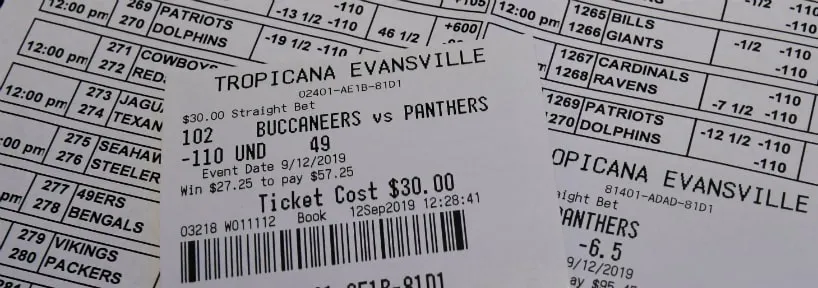
Rotation numbers are unique identifiers assigned to every game. They’re most commonly used at retail sportsbooks, where bettors can quickly tell a ticket writer which wager they’d like to place.
For example, instead of saying, “I’d like the Cowboys -8,” you could simply ask for “403,” meaning Cowboys -8. While rotation numbers aren’t necessary when betting online, they’re still useful to recognize if you visit a physical sportsbook.
Point Spreads
Point spreads are designed to balance the matchup between two teams by giving the favorite a scoring handicap.
- Favorite: Cowboys -8
- Underdog: Chiefs +8
If you bet the Cowboys -8, they must win by nine or more points for your wager to cash.
If you bet the Chiefs +8, your bet wins if they either:
- Win the game outright, or
- Lose by seven points or fewer.
If the Cowboys win by exactly eight points, the bet is a push, and your stake is refunded.
Totals (Over/Under)
A total, commonly called an over/under, is a wager on the combined score of both teams rather than the game’s winner.
Using a total of 42.5:
- Over 42.5: You win if 43 or more total points are scored.
- Under 42.5: You win if 42 or fewer total points are scored.
Because the line includes a half-point, there’s no possibility of a push.
Moneyline Bets
A moneyline bet is simply a wager on which team will win the game. The margin of victory doesn’t matter.
In this example:
- Cowboys -400
- Chiefs +300
The Cowboys are heavy favorites, while the Chiefs are significant underdogs.
Negative Odds
Negative odds show how much you must risk to win $100.
A –400 moneyline means:
- Bet $400 to profit $100.
- Bet $40 to profit $10.
- Bet $100 to profit $25.
Positive Odds
Positive odds show how much profit you’d earn on a $100 wager.
A +300 moneyline means:
- Bet $100 to profit $300.
- Bet $50 to profit $150.
- Bet $20 to profit $60.
Favorites pay less because they’re expected to win more often, while underdogs offer larger payouts in exchange for a lower probability of winning.
What Is the Vig (Juice)?
The vig, also called the juice, is the sportsbook’s commission for taking your bet.
Most point spreads and totals are priced at -110, meaning you’d risk $110 to win $100.
That doesn’t mean you have to wager $110. The payout scales to any bet size:
- Bet $11 to win $10.
- Bet $22 to win $20.
- Bet $55 to win $50.
Moneylines also include vig, though it’s built directly into the listed odds.
Understanding the vig is important because it affects your long-term profitability. The lower the juice you pay, the easier it is to become a winning bettor over time.
Key Takeaways
Before placing your first wager, remember these fundamentals:
- Point spreads predict the margin of victory.
- Moneylines are bets on the outright winner.
- Totals (over/under) are wagers on the combined score.
- Negative odds indicate the favorite.
- Positive odds indicate the underdog.
- The vig (juice) is the sportsbook’s commission built into every wager.
Once you’re comfortable reading odds, you’ll be better equipped to compare lines, understand payouts, and make more informed betting decisions.