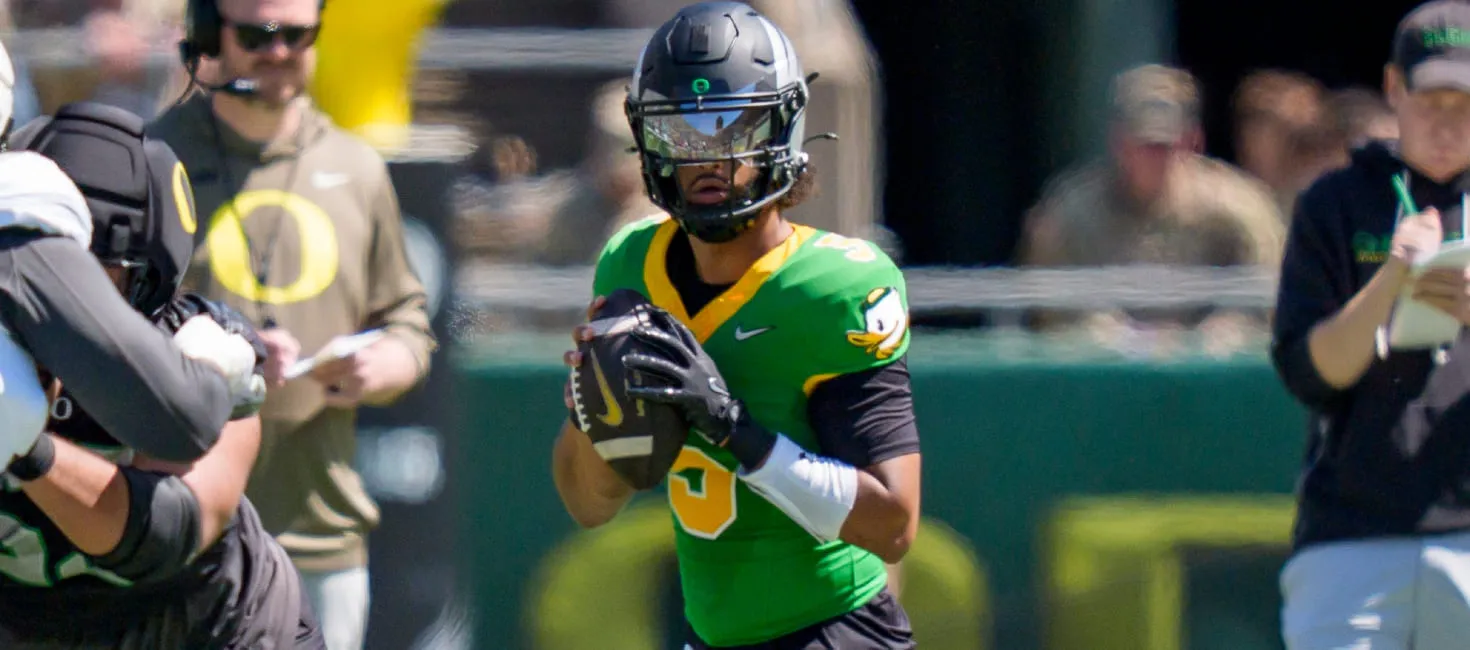
Week 0 of the 2026 college football season featured some incredible performances. Virginia quarterback Beau Pribula dazzled with 110 yards on the ground in a 34-8 win versus NC State, while four different Trojans scored rushing touchdowns in USC’s 42-26 triumph over San Jose State. The focus now shifts to a Week 1 slate packed with intriguing storylines and ranked teams in action. Here's a look at my favorite college football picks for Saturday's game Boise State vs. Oregon.
- More NCAAF Betting Advice
- Expert Game Picks for College Football
- Top Bettor Picks for College Football
- NCAAF Betting Strategy
Get instant alerts when a line reaches your target via the BettingPros App >>

Saturday's Best College Football Picks: Boise State vs. Oregon (Week 1)
(Odds courtesy of FanDuel Sportsbook)
Boise State Broncos vs. No. 2 Oregon Ducks
Early out-of-conference showdowns rarely have true playoff implications. However, that is the case when Boise State and Oregon meet at Autzen Stadium on Saturday. The Broncos are the favorite to win the Pac-12 Conference (+140 on FanDuel), making them a legitimate challenger for the non-power conference playoff spot. Quarterback Maddux Madsen and running back Dylan Riley bolster an offense that recorded top-25 marks in yards per game (455) and third-down conversion rate (45.3%) in 2025.
On the other side, Oregon is praised as a title contender thanks to a balanced roster. Quarterback Dante Moore opted to return to the Ducks over a chance to get drafted in the NFL. The junior signal-caller impressed by completing 71.8% of his passes for 3,565 yards and 30 touchdowns (10 interceptions) this past fall. Take note that head coach Dan Lanning’s squad ranked 13th in points per game (35.4) and 11th in opponent points per game (18.2) in a dominant 2025 season (13-2 record).
Facing a Big 10 defense is a different kind of beast. Madsen knows that well, connecting on just 51.6% of his passes for 503 yards and two touchdowns (five interceptions) in three career outings against a Big 10 foe. Boise State has proven it can find an offensive groove, yet it’s also proven it can hit a wall. The Broncos scored 10 or fewer points in all five of their losses last year. They didn’t score a single second-half point in four of those five defeats. Trust Oregon’s depth to prevail in a strong defensive performance.
Pick: Boise State Team Total Under 13.5 Points
How to Make Money Betting on College Football: 10 Strategy Tips to Profit
College football is one of the toughest sports to bet well, given how many teams are on the board every week and how uneven the available information is between programs. Here are ten durable strategy principles for approaching the sport profitably, count down style.
10. Bet the number, not the team
With well over a hundred teams to choose from every week, the goal isn’t to find a team you like and bet it regardless of price. It’s to find spots where the market as a whole, or one specific sportsbook, has priced a game incorrectly. Shopping the same game across multiple books can reveal real value on a line that looks unremarkable at first glance. The more popular a team is, the more attention the market pays to it and the sharper that line tends to be, so real value is often easier to find in less-followed matchups.
9. Know the odds you’re actually betting
Most bettors gravitate toward spreads and totals without fully internalizing what the odds actually require to break even. A standard minus-110 bet needs to hit at roughly 52.4% just to profit, and lines are generally shaded slightly toward favorites and unders because that’s what the betting public tends to prefer. That shading is usually modest, often just a percentage point or two, but it’s the difference between a bet that’s profitable long term and one that isn’t. Know the required win rate for whatever odds you’re taking before you place the bet, not after.
8. Shop around and use as many outlets as possible
Access to multiple sportsbooks, and increasingly prediction markets, is close to a requirement for a serious college football bettor. The same game can carry meaningfully different lines and different odds at different books, and even a half-point or a few cents of juice can be the difference between a winning ticket and a losing one over a full season. Keeping funds spread across multiple platforms rather than concentrated in one makes it possible to actually capture that value when it appears, and opening lines early in the week tend to show the widest gaps between books.
7. Be careful with parlays
Every additional leg on a parlay dramatically lowers the odds of it actually hitting, even when each individual leg looks like a reasonably safe bet on its own. A single standard leg near even odds might hit around half the time, but two legs cuts that roughly in quarters, and by four or five legs the realistic hit rate is in the single digits. Parlays are fun and the occasional big one is a nice bonus, but they shouldn’t be treated as a core strategy. If you do build them, scale down the unit size relative to a straight bet, especially once you’re past two legs.
6. Don’t be afraid to tease to a key number
Teasing costs extra juice and reduces payout, but it also means you only pay that cost if you lose. Getting off a bad number and onto a key number, the common margins games are actually decided by, can be worth the reduced payout, especially betting favorites down through those numbers or underdogs up through them. The caveat is not to overdo it: if you’re teasing so far that you’re functionally betting the opposite side of the original line, it’s worth asking whether you should have just bet that side directly instead.
5. Factor in context: schedule, travel, and situational spots
Every game carries situational context beyond the raw matchup. Rivalry games tend to play closer than the numbers suggest. A team facing a big opponent this week and a much easier one next week can be a real look-ahead risk. A team that just pulled off a huge upset is a real letdown risk against a lesser opponent the following week. Long or unusual travel, a coaching change that can produce a short-term effort boost from players, and whether a team is a home underdog are all real, recurring factors worth weighing before placing a bet, not just the two teams’ talent levels on paper.
4. Take advantage of promotions, but avoid the traps
Sportsbooks routinely offer promotions like odds boosts, no-sweat bets, and bonus bets, especially early in the season and around marquee events like the playoff and bowl season. These are worth using since they offer a real edge against the house that doesn’t normally exist. But some promotional categories are traps rather than value: heavily boosted same-game parlays are usually structured to encourage adding more legs than you should, pre-built promotional parlays often bundle in a leg the book’s own risk team doesn’t like, and celebrity-endorsed picks or parlays carry no real analytical edge just because a recognizable name is attached. Use genuine promotions, skip the manufactured ones.
3. Check the weather and understand what it actually does
Weather has a real, measurable effect on scoring, but mostly at the extremes. Temperatures in a broad middle range have little impact, while unusually hot or unusually cold games tend to push toward more rushing and lower scoring as players tire or struggle to move. Wind is the single biggest weather factor: modest wind does little, but once it climbs past a real threshold, field goal accuracy and distance both drop noticeably, an effect that’s even more pronounced on college kickers than professional ones. Heavy rain tends to push toward more rushing and lower scoring, and also makes big, unpredictable plays like fumbles and slips more likely, which is a good reason to lean toward player props over spreads or totals in a rain game. Snow has a similar rushing-and-lower-scoring effect once it’s heavy enough to accumulate, while light flurries generally don’t matter much. Pair weather research with injury report research, since college programs vary widely in how transparent and up to date their injury reporting actually is.
2. Bet favorites early in the week, underdogs and unders later
The betting public tends to gravitate toward favorites and overs, which means those lines are often at their best value early in the week, particularly right after the previous week’s slate wraps up, before public money pushes them further in that direction. Underdogs and unders, by contrast, tend to get better value later in the week as that public money accumulates. This isn’t foolproof, since real news like injuries, weather updates, or a sudden shift in public attention can move a line unpredictably in either direction, but it’s a reasonable default approach. Popular, heavily bet programs are also more likely to see their lines move further from true value during the week than lesser-followed teams, since the volume of public money on those games is simply higher.
1. Try to talk yourself out of your own bet
Before placing a bet you feel good about, take a moment to genuinely argue the other side. Write out or think through the real reasons the bet could lose, not just the reasons you like it. Sometimes this exercise turns up more real concerns than expected and changes the decision entirely; other times it simply confirms the original read and gives real confidence to proceed. When there are several appealing bets in a given week, ranking them by conviction and allocating bet size accordingly, rather than treating every pick as equally strong, is a related discipline worth building into a regular routine.